
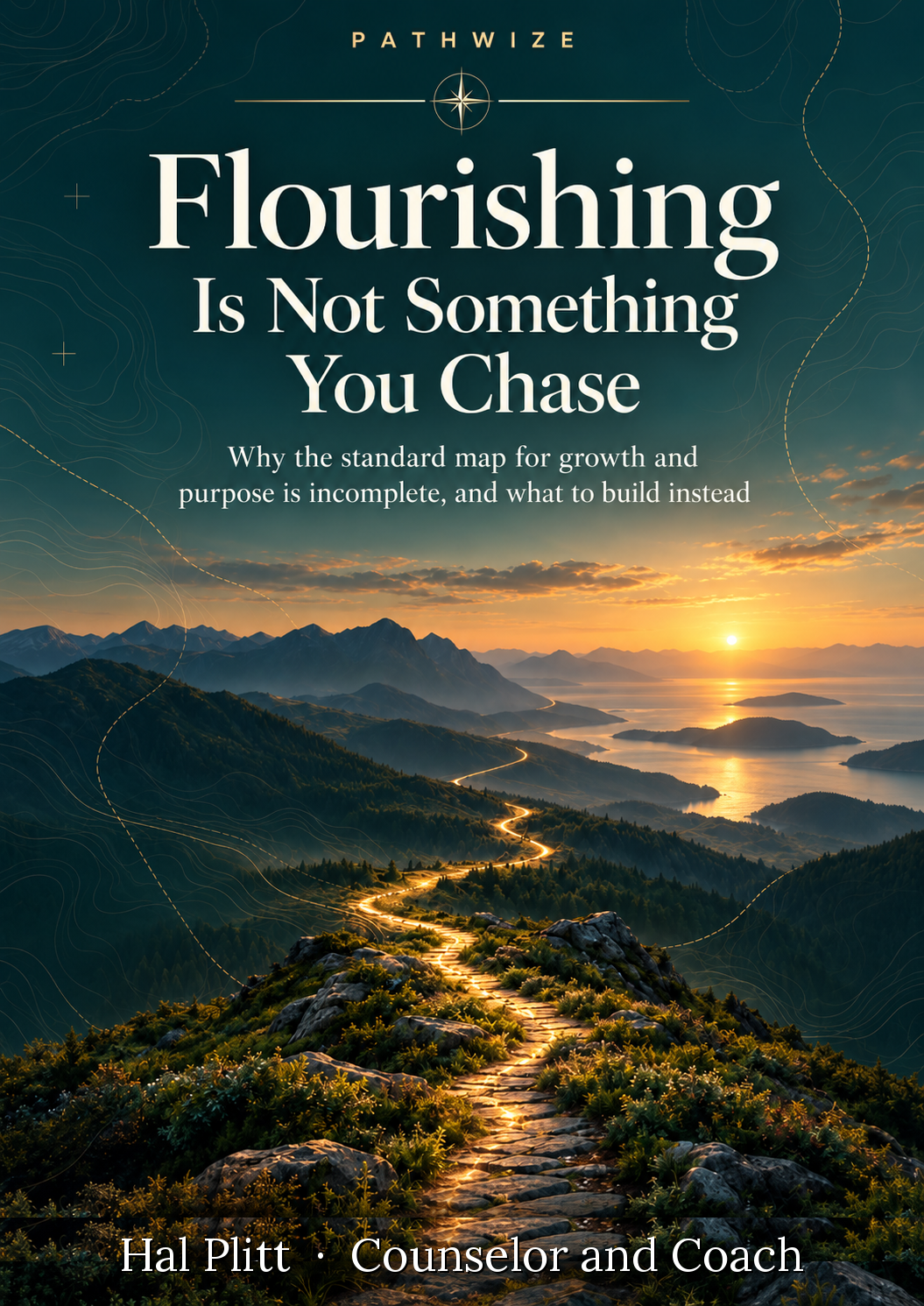
Flourishing Is Not Something You Chase
Most growth frameworks start where the culture starts — with outcomes. Pick a goal. Optimize toward it. Measure your progress. The problem isn’t that goals are useless. The problem is that a goal aimed at the wrong target is worse than no goal at all. This book starts somewhere else.
Picture someone who has done almost everything right. They chose a direction, worked hard at it, built something real, earned the recognition that comes with sustained effort. From the outside, their life looks exactly like success.
And yet — the work feels thinner than it should. The direction feels arbitrary. The frameworks they have tried produce results that look right on paper and feel incomplete on the inside. Underneath the visible achievement, a quiet and uncomfortable question surfaces: Is this actually it?
This is not a crisis. It is a signal. And most of the tools available in the culture — goal-setting systems, productivity frameworks, purpose worksheets — are not designed to answer it. They are designed to optimize a direction you may not have chosen clearly in the first place.
This book was written for that person. Not someone who is broken or lost. Someone who has been competent and disciplined and accomplished — and who is now asking a more honest question about what all of that competence is actually in service of.
What This Book Is
Flourishing Is Not Something You Chase is a 396-page developmental framework for people who are serious about the question of how to live well. It is not a self-help book. It is not a goal-setting system. It is a serious, grounded account of what human development actually requires — and why most popular approaches miss what matters most.
The book draws on psychology, neuroscience, philosophy, developmental science, and nearly four decades of professional experience to build a coherent argument: flourishing is not achieved. It is developed, through greater congruence between who you are, what you believe, and how you live.
47 Chapters. 5 Parts. One Coherent Argument.
Part One: The Wrong Map
Most people are navigating with a map that was handed to them by their culture, their environment, or someone else’s expectations. This section names the problem: what it costs to optimize toward the wrong things, and why conventional wisdom about purpose and success so often leads people somewhere they didn’t actually intend to go.
Part Two: Know Yourself First
Before direction comes self-knowledge. This section builds the foundation — identity, values, character strengths, emotional intelligence, attachment patterns, cognitive filters, and the difference between who you want to be and who you actually are. Self-knowledge is not a detour. It is the map.
Part Three: Develop Deliberately
Understanding yourself is not the same as changing. This section addresses the work of genuine development — how insight becomes practice, how practice becomes character, what mastery actually requires, and how to grow inside a world that doesn’t always support it.
Part Four: Know Your Direction
With self-knowledge in place, the question becomes: what are you building, and why? Purpose, motivation, meaning, the seasons of a life, navigating transitions — this section addresses direction not as an outcome to achieve but as a compass to calibrate.
Part Five: Stewardship
The culminating question of mature development: what do you do with what you’ve been given? Contribution, systems thinking, leverage, and the shift from self-development to responsibility for something larger than yourself.
The book also includes a full reference section, a glossary of key concepts, and an appendix presenting the Integrative Human Development Model (IHDM).
Who This Is For
This book is for people who are past the beginner questions and ready for a more demanding one. It is for the leader who has achieved what they aimed for and senses that something is still missing. The professional who is competent, capable, and quietly wondering whether the direction deserves the investment. The person in transition who wants to think seriously about what comes next — not just what will work, but what actually fits. The counselor, coach, or practitioner who wants a coherent developmental framework to work from.
It is not for people looking for a quick fix, a motivational jolt, or a system for optimizing their existing direction. It is for people who are willing to do the harder and more honest work.
About the Author
Hal Plitt spent nearly four decades in fire service — Air Force, Air National Guard, and five municipal organizations — rising through the ranks from firefighter to training captain, running recruit academies and officer development programs, and accumulating nearly twenty certifications across the full arc of fire service roles.
He completed a Bachelor of Science in industrial-organizational psychology in 2019 and a Master of Arts in clinical mental health counseling in 2024. He holds licensure as a Licensed Professional Counselor Associate (LPCA) in South Carolina and as a Licensed Professional Clinical Counselor (LPCC) in Colorado, and has completed his training in professional coaching.
He is the founder of PATHWIZE — a coaching and human development practice built on the principle that flourishing is not achieved. It is developed.
What You Receive
Your purchase includes two PDF editions of the book:
The Standard Edition — a light, print-optimized layout designed for comfortable screen reading and printing.
The Dark Edition — a rich navy and gold design formatted for digital reading, suited to readers who prefer a more visually distinctive experience.
Both editions are identical in content. You choose how you read.
$27.00
Instant digital delivery. Both editions included.
This is a PDF download. You will receive access to both the Standard Edition and the Dark Edition immediately after purchase. No subscription, no recurring charge. PATHWIZE LLC is the publisher of record.